



In the heavy industries of mining and civil construction, the term “bolt” usually conjures images of massive steel shafts securing tunnel roofs. But there is another type of bolt that is just as vital to keeping a site operational and safe. That is the electrical split bolt. Whether you are wiring a high-voltage generator, grounding a mesh wall, or repairing damaged cables deep underground, understanding how to properly use these small but mighty fasteners is essential. This guide will walk you through exactly what they are, why material choice matters, and how to create a fail-proof connection. Why should you read this? Because a loose wire deep in a mine shaft is not just an inconvenience; it is a critical safety hazard. Let’s get down to the data.
What exactly are split bolts and how do they work?
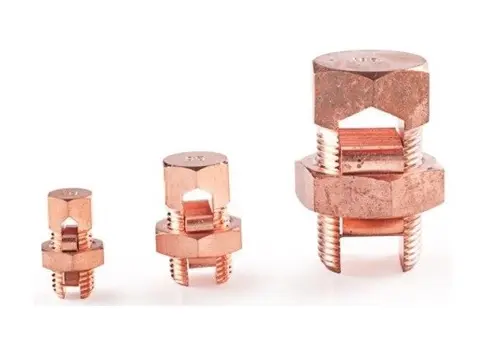
When you look at a split bolt connector, it looks beautifully simple. It is essentially a thick metal bolt that has a deep slot or split cut right down the middle of its threaded shaft. The design includes a matching nut and sometimes a pressure bar. The open slot allows you to drop two or more cables directly into the center of the bolt without needing to thread them through a closed hole.
Once the cables are nestled in the split, you thread the nut over the top. As you tighten the nut down with a wrench, it forces the sides of the split together and crushes the cables tightly against each other. This immense mechanical pressure is what creates a highly conductive pathway between the cables.
In my years supplying hardware to sites in Australia and the USA, guys like Grant—a no-nonsense procurement manager—demand parts that do not fail under pressure. While we normally talk about the tonnage a Split rock friction anchor can hold, an electrical split bolt connector holds something just as volatile: raw electricity. These wire connectors squeeze the strands of metal so tightly that they act almost as a single piece of solid metal.
When do you need to use a split bolt connector for a wire?
You will generally need to use a split bolt connector when you are dealing with heavy-gauge cables that are too thick for standard twist-on wire nuts. Think about the main power feeds coming into a temporary site office, or the heavy cables running from a diesel generator.
A common application is a “tap” connection. This is where you have a main, continuous wire running along a wall, and you need to branch off a smaller wire to feed a specific piece of equipment. Because of the open slot, you do not have to cut the main line. You simply strip away a section of the insulation, lay the bare main cable into the split, lay the branch cable on top of it, and torque it down.
These fasteners are also widely used for making heavy-duty splices. If a piece of machinery rolls over a cable and severs it, you can easily splice the two halves back together to repair the line and get the power flowing again. They are a versatile, heavy-duty tool in any electrician’s kit, designed to connect quickly and extend lines across vast job sites.
Are copper split bolt connectors the best choice for electrical applications?
The short answer is yes. Copper split bolt connectors are the industry standard for joining copper cables. When it comes to electricity, you want the materials of your wire connections to match. Split bolt connectors are made from a few different materials, but a high-grade copper alloy is by far the most popular.
Why? It comes down to thermal expansion and conductivity. When electricity flows through a joint, it creates heat. Metals expand when they get hot and contract when they cool down. If you use a connector made of a different metal than your cables, they will expand and contract at different rates. Over time, this microscopic wiggling will loosen the joint. A loose joint arcs, sparks, and eventually burns out.
By using pure copper or a high-strength bronze alloy for your split bolts, you ensure the connector expands and contracts at the exact same rate as the copper wire. This makes the choice of material critical. It ensures the connection stays permanently secure, which is exactly what safety-obsessed engineers demand.
How do you properly use split bolt wire connectors to join cables?
Knowing how to use split bolt hardware properly is a matter of following strict steps. Skipping a step can lead to a dangerous fault. Here is the straightforward process my clients use in the field to make secure splices.
First, you must strip the outer jacket off the cables. You need to expose enough bare metal so that the wires can lay flat against each other inside the slot without any rubber or plastic getting trapped under the nut. Usually, exposing about an inch or so of bare metal is sufficient.
Next, take the ends of the wires and clean them. If the copper is oxidized (turned green or dark brown), hit it with a wire brush until it shines. Then, slide the cables into the split. Make sure they are parallel to each other. Do not twist them around each other like a braid.
Finally, thread the nut onto the bolt and crank it down. You must apply serious torque here. Use two wrenches: one to hold the body of the bolt and the other to turn the nut. You want to crush those wires together until there are no air gaps between the individual wire strands. This is how you join cables safely.
What makes a long-lasting split bolt application in heavy industry?
To create a long-lasting connection in a brutal environment like an underground mine or a desert construction site, the mechanics of the fastener must be flawless. You cannot afford for a joint to vibrate loose when heavy drills and excavators are rumbling overhead.
The secret to their durability is the sheer clamping force they generate. Because a Bolt relies on inclined plane mechanics (the threads), turning the nut translates rotational force into massive linear clamping force. This pressure literally cold-welds the cables together.
Furthermore, to keep the environment out, the job isn’t finished until the joint is wrapped. A bare metal joint in a damp tunnel will corrode in weeks. A truly reliable installation requires waterproofing. When you put a heavy-duty connector in place, it must be treated as a permanent part of the system.
Can bolt connectors be used for copper and aluminum wire?
This is a critical question that causes a lot of confusion. Can you mix metals? Generally speaking, bolt connectors can be used for copper and aluminum wire, but only if you buy a specifically designed dual-rated connector.
If you put an aluminum cable and a copper cable into a standard copper connector, you will trigger galvanic corrosion. The metals will chemically react with each other, turning into a powdery white dust, and the connection will fail spectacularly.
To safely join these two different metals, connectors are typically plated with tin. You will see these sold as “AL9CU” rated connectors. These tin-plated split bolts act as a neutral barrier. Additionally, most of these dual-rated connectors come with a separator bar—a small piece of metal that sits inside the split between the two cables, so the copper and aluminum never physically touch each other.
How do you size a copper split bolt for the right wire strand?
Getting the right size is crucial. If the bolt is too small, you won’t be able to fit both cables into the slot. If it is too large, the nut will bottom out on the threads before it actually clamps down on the cables, leaving you with a dangerously loose joint.
Connectors are sized based on American Wire Gauge (AWG). You will typically see a range stamped on the side of the bolt, such as “#8 to #2 AWG”. This means it is suitable for wires within that thickness bracket.
| Bolt Size Rating | Min Wire Size (AWG) | Max Wire Size (AWG) | Common Application |
| Small | #10 | #6 | Lighting, small motors |
| Medium | #8 | #2 | Sub-panels, large machinery |
| Large | #2 | 2/0 | Main power feeds, heavy grounding |
| Extra Large | 1/0 | 250 kcmil | High-voltage industrial lines |
You also need to consider if your cable is solid copper or stranded. A thick strand cable is bulkier than a solid wire of the same gauge because of the air gaps between the strands. Always read the manufacturer’s spec sheet to ensure the bolt can handle the physical volume of the cables you intend to use.
Why is grounding with a split bolt crucial for safety?
In mining and tunneling, grounding is a matter of life and death. When you have high-voltage equipment running in wet, muddy conditions, any stray current needs a clear, unobstructed path straight into the earth. If it doesn’t find the earth, it will find a person.
We supply a massive amount of Diamond Mesh for tunnel walls. Often, engineers will use a split bolt connector to bond heavy copper grounding cables directly to the structural steel mesh. This creates a massive, localized grounding grid.
To do this, they expose a section of the grounding cable, lay it against the steel, and lock it down with the connector. Because these bolts can exert such high clamping force, they can bite through surface rust or dirt on the steel, ensuring a perfect metal-to-metal bond. This guarantees that if a machine shorts out, the electrical surge is safely dumped into the rock wall, protecting the operators.
What are the steps to insulate and protect split bolt wire connections?
One of the biggest drawbacks of split bolts is that once installed, they leave a massive, awkward lump of bare metal exposed. You cannot leave it like this. Rebuilding the insulation over the joint is arguably the most important part of the installation.
Because of the sharp corners of the nut and the bolt threads, standard electrical tape is not enough. The sharp edges will eventually cut through thin tape. You must build a thick covering.
- Pad the corners: Start by taking a roll of thick rubber splicing tape (often called mastic tape). Stretch it out and wrap it tightly around the entire connector. This forms a thick, rubbery lump that pads the sharp edges.
- Seal it: Once you have a smooth, rubbery ball over the connector, cover it with three or four tight layers of high-quality vinyl electrical tape.
- Weatherproofing: If the joint is exposed to dripping water or mud, finish it with a coat of liquid electrical tape or heat shrink tubing (if you can slip it over the end of the wire).
This multi-layer approach ensures your electrical connections are completely sealed from moisture, dirt, and accidental contact.
How does the split design keep the connection secure over time?
The genius of the split design lies in its simplicity. Unlike mechanical lugs that use a small set screw to press against the cable, a split bolt grabs the cables from all sides.
When you tighten a set screw, the tip of the screw crushes only one small spot on the top cable. If that cable shifts or settles over time, the screw becomes loose. However, when you tighten the heavy-duty nut on a split bolt connector, the walls of the U-shaped body pull upward while the nut pushes downward. The cables are entirely encased and compressed into a tight, solid bundle.
This variety of 360-degree compression ensures that even under heavy thermal cycling (heating up during the day under heavy load and cooling off at night), the structural integrity of the joint remains intact. It is the same philosophy we use when designing our ground support Nut assemblies—maximum surface contact equals maximum security.
Summary: Key Takeaways for Split Bolt Applications
To ensure safety and reliability on your job site, keep these critical points in mind:
- Purpose: Split bolts are heavy-duty fasteners used to splice, tap, or join thick electrical cables securely.
- Material: Always match materials. Use copper split bolt connectors for copper wires to prevent thermal expansion failures.
- Preparation: You must strip the wire cleanly and expose bright metal to ensure maximum conductivity.
- Torque: These are not hand-tightened fittings. You must use wrenches to crush the wires together to make a safe joint.
- Insulation: Never leave a installed bolt bare. Use rubber splicing tape followed by vinyl tape to create a safe, waterproof covering.
- Sizing: Check the AWG range on the bolt to ensure it is suitable for the physical bulk of the cables you are connecting.
- Safety: They are an essential tool for creating reliable earth grounding grids in harsh industrial environments.
When you treat your electrical hardware with the same respect as your structural steel, your operations will run smoothly, safely, and without expensive downtime.
Post time: Mar-26-2026