



In the world of mechanical engineering and construction, precision is paramount. The choice of a fastener is never arbitrary; it’s a calculated decision based on load, stress, and the specific demands of the joint it will secure. While many bolts may look similar, subtle differences in their design specifications can have a massive impact on performance and safety. The DIN 931 hex head bolt is a perfect example of this. It is a fastener designed for specific, demanding applications where strength and alignment are critical. This guide will explore the defining characteristics of the DIN 931 standard, explain why its partially threaded design is so important, and clarify how it differs from its fully threaded counterpart, the DIN 933, to help you make the right choice for your project.
What is the Defining Feature of a DIN 931 Hex Bolt?
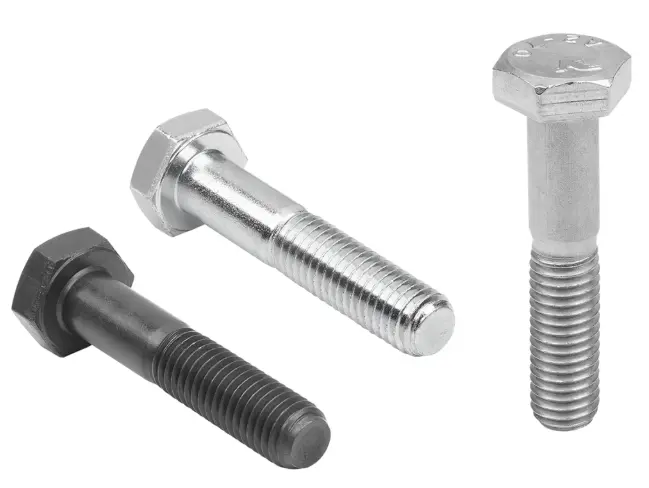
The DIN 931 standard specifies a hex head bolt with a partial thread. This is its most important characteristic. Unlike a fully threaded bolt, a DIN 931 fastener has a smooth, unthreaded portion of its body, known as the shank, between the head and where the thread begins. This design is intentional and serves a critical purpose in many structural and mechanical assemblies.
The standard itself, created by the German Institute for Standardization (Deutsches Institut für Normung), provides precise specifications for the bolt‘s dimensions, material properties, and tolerances. While the original DIN 931 standard is widely referenced, it has been largely superseded by the international standard ISO 4014. However, the term DIN 931 remains common in the industry to describe a partially threaded hex bolt. This design choice directly impacts how the bolt handles different types of forces, making it distinct from a fully threaded screw or bolt.
Why is a Partial Thread and a Shank Important for an Application?
The unthreaded shank of a DIN 931 bolt is its key advantage in certain applications. This smooth portion of the bolt is designed to handle shear forces—forces that act perpendicular to the length of the fastener. The solid shank has a larger cross-sectional area than the threaded portion, giving it greater shear strength. When a joint is subjected to sideways stress, the shank bears the load, providing a more robust and reliable connection than a bolt that is threaded along its entire length.
Furthermore, the shank provides a precise and snug fit in close-tolerance holes. This is crucial for applications that require accurate alignment of multiple components. The smooth surface of the shank acts as a dowel, preventing movement and ensuring parts are held firmly in their intended position. A fully threaded bolt, in contrast, can have a slightly looser fit and is not designed to handle significant shear loads, making the DIN 931 the superior choice for demanding structural joints in construction and machinery.
How do DIN 931 and DIN 933 Fasteners Differ?
The primary and most obvious difference between a DIN 931 bolt and a DIN 933 bolt is the thread length.
- DIN 931 (ISO 4014): This is a partially threaded hex head bolt. It has a smooth shank and a specific thread length at the end. It is designed for applications where shear strength and precise alignment are critical.
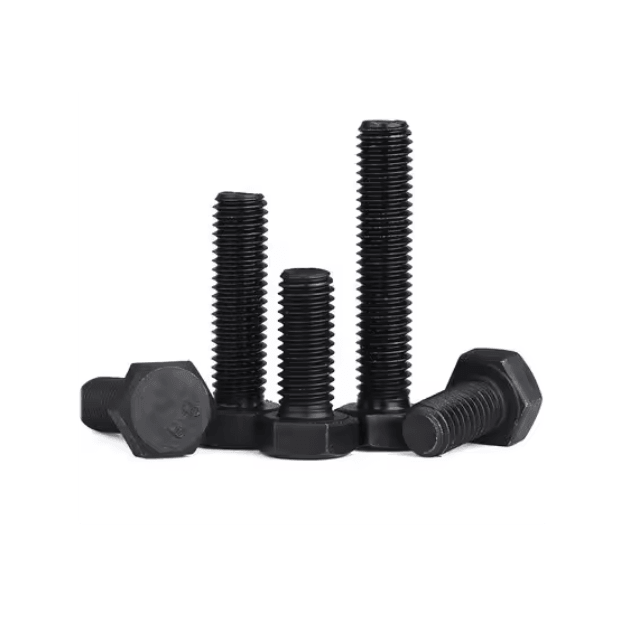
- DIN 933 (ISO 4017): This is a fully threaded hex head bolt. The thread runs the entire length of the body, from under the head to the tip. This design is ideal for applications where full clamping force is needed, such as when the bolt is threaded into a tapped hole or used with a nut where the grip length is paramount.
Choosing between the two depends entirely on the forces at play in the joint. For fastening that primarily involves tension (pulling force), a DIN 933 is often suitable. For joints that must resist shearing forces, the DIN 931 is the correct engineering choice.
What Do the Material and Grade Designations Mean?
Like most fasteners, DIN 931 bolts are available in a variety of materials and strength grades to suit different applications. The material choice impacts factors like corrosion resistance, while the grade defines the mechanical strength of the bolt.
Common materials include carbon steel, alloy steel, and stainless steel. Stainless steel is chosen for its ability to resist rust and is often used in marine or chemical environments. Carbon and alloy steels are typically coated (e.g., zinc-plated) for protection and are selected for their high strength.
The strength is indicated by a property class or grade, such as 8.8, 10.9, or 12.9 for metric bolts. For example, in a Grade 8.8 bolt:
- The first number (8) represents the ultimate tensile strength, which is 800 megapascals (MPa).
- The second number (8) indicates that the bolt will begin to yield at 80% of its ultimate tensile strength.
Higher numbers indicate a stronger fastener. Choosing the correct grade is essential to ensure the bolt can handle the loads of its intended application without failing. Using a lower-grade bolt than specified is a serious safety risk.
Understanding DIN 931 Dimensions and Metric Sizes
The DIN 931 and its successor, ISO 4014, provide a comprehensive set of dimensions to ensure global interchangeability. When ordering a DIN 931 hex bolt, you need to specify several key parameters to get the correct size.
The basic designation looks like this: Hexagon head bolt ISO 4014 M12 x 80 – 8.8
- M12: This indicates the nominal thread diameter, which is 12 mm for this metric bolt.
- 80: This is the nominal length of the bolt in millimeters, measured from under the head to the tip.
- 8.8: This is the property class or strength grade of the fastener.
The standard also defines other critical dimensions, including the width across the flats of the hex head, the head height, and the specific thread length for a given bolt size and length. Adhering to these standard dimensions ensures that the bolt will fit correctly with standard tools and its corresponding nut. For a variety of nut options, you can see our selection on the Nut page.
What are the Common Applications for This Type of Bolt?
The unique properties of the DIN 931 hex head bolt make it essential in a wide range of industries where structural integrity is crucial. Its ability to withstand high shear loads makes it a staple in applications that involve aligning and joining heavy components.
You will commonly find DIN 931 bolts are used in:
- Construction: For steel-to-steel structural connections in buildings and bridges where lateral forces are significant.
- Automotive Industry: In engine mounts, suspension components, and chassis assembly where precise alignment and resistance to vibration and shear are necessary.
- Heavy Machinery: For assembling frames, mounting engines, and connecting moving parts on industrial and agricultural equipment.
- Renewable Energy: In the assembly of wind turbine towers and solar panel mounting structures.
In all these cases, the fastening requires more than just clamping force; it requires the strength and stability that only a partially threaded bolt with a solid shank can provide. The correct washers are also critical, as seen on our Washer page.
Why Choosing the Right Screw or Bolt Matters
Selecting the correct fastener is not just about finding one that fits. It’s about ensuring the long-term safety, reliability, and performance of the entire assembly. Using a fully threaded DIN 933 bolt in a joint that is primarily under shear stress is a common mistake that can lead to premature failure. The threads act as stress concentrators and can be damaged under shear load, compromising the integrity of the connection.
Conversely, using a DIN 931 bolt where the thread does not fully engage with the nut or tapped hole can result in insufficient clamping force. This is why understanding the design intent behind each standard is so important. A DIN 931 is a specialized bolt for a specific job, and its correct application is a hallmark of quality engineering and assembly. The same principle applies to other fastening systems, such as the Split rock friction anchor, which is also designed for a very specific application.
Key Takeaways
- Defining Feature: A DIN 931 (ISO 4014) hex head bolt is partially threaded, featuring a smooth, unthreaded shank between the head and the thread.
- Shear Strength: The solid shank gives the DIN 931 bolt superior strength against shear forces (sideways loads) compared to a fully threaded bolt.
- Precise Alignment: The unthreaded shank also serves as a dowel for accurately aligning components in close-tolerance holes.
- DIN 931 vs. DIN 933: The key difference is the thread length. DIN 931 is partially threaded for shear resistance, while DIN 933 (ISO 4017) is fully threaded for maximum clamping force and tension applications.
- Grade is Critical: The property grade (e.g., 8.8, 10.9) indicates the strength of the bolt and must be matched to the application‘s load requirements.
- Application is Key: Always choose the fastener based on the type of forces the joint will experience. Use DIN 931 for shear loads and DIN 933 for tension loads.
Post time: Jan-21-2026