



In the world of heavy industry, construction, and mining, time is money and structural integrity is everything. Whether you are securing metal sheets for a workshop roof or fixing brackets in a tunnel, knowing your fastener types can save you hours of labor and prevent costly failures. The confusion between the self-tapping screw and the self-drilling screw is common, even among seasoned pros. While they might look similar in a handful, they function differently. This article breaks down the mechanics, the thread designs, and the specific use cases for each, ensuring you pick the right tool for the job every single time.
What exactly is a self-tapping screw and how does it work?
A self-tapping screw is a fastener designed to create its own thread as it is driven into a material. Think of it as a screw that carves its own path. However, there is a catch that catches many people off guard: most self-tapping screws cannot drill their own hole. They generally require a pilot hole to be pre-drilled before installation. The “tapping” part refers to the screw’s ability to cut or form threads inside that pre-drilled hole, locking the fastener securely in place.
These types of screws come in various shapes, including blunt-nosed, pointed, and flat-ended. When you look closely at the thread, you will notice it is often sharp and hard. This design allows the self-tapping screw to slice into softer materials like wood, plastic, or light gauge metal. In the context of our industry, we often see these used in non-structural paneling or attaching fixtures where a hole has already been punched or drilled during fabrication.
The term “self-tapping” is actually a broad category. It includes thread-cutting screws, which physically remove material to create the thread (much like a tap set), and thread-forming screws, which displace the material without removing it. Thread-forming creates a tighter fit and is excellent for materials that might crumble, but it requires more driving force. If you are working with sheet metal screws, you are almost certainly handling a variation of a self-tapping screw.
What is a self-drilling screw and why is it like a drill bit?
A self-drilling screw, often referred to by the brand name Tek screws, is a powerhouse of efficiency. The defining feature of this fastener is its tip. If you look at the end of the screw, it looks exactly like a drill bit. It has flutes and a cutting point designed to carve through solid metal without needing a pilot hole. This small design change revolutionizes assembly time on a job site.
When you use a self-drilling screw, the drill point acts first, boring a hole through the material. As the screw advances, the threads following the point engage with the newly created hole, tapping it immediately. This means a self-drilling screw is technically a self-tapping and self-drilling hybrid. It drills, taps, and fastens in one single motion. For a procurement manager like Grant, who values speed and reducing downtime, these screws are a staple for maintenance and quick repairs.
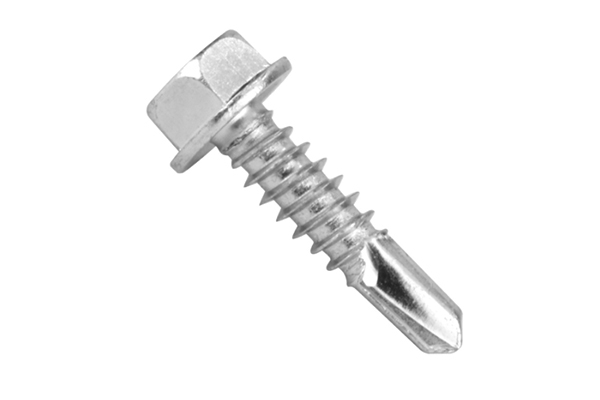
It is important to note that the length of the drill point determines the thickness of the metal the screw can penetrate. A screw with a longer “flute” (the groove that removes metal chips) can drill through thicker steel. If you try to use a self-drilling screw with a short point on heavy structural steel, the flutes will clog, the heat will build up, and the screw will snap. Always match the drill point number (Tek 1, 2, 3, etc.) to the material thickness.
The core difference between self-drilling and self-tapping screws explained
The fundamental difference between self-drilling and self-tapping screws lies in the preparation required. Self-tapping screws are about thread engagement. They need you to do the hard work of drilling a hole first. Self-drilling screws are about process elimination. They do the drilling for you. If you pick up a screw and it has a sharp, pointy tip like a pencil, it is likely a self-tapping screw. If it has a tip that looks like the end of a twist drill, it is a self-drilling screw.
Understanding this difference between self-tapping and self-drilling creates safer work environments. In mining and tunneling, we use massive versions of these concepts. For example, our Self-drilling Hollow Anchor acts on the same principle as a small self-drilling screw but on a massive scale for rock reinforcement. It allows crews to drill and grout in loose rock without the hole collapsing, just like a Tek screw allows you to fasten metal without the alignment issues of pre-drilling.
Another key difference is thread pitch. Self-drilling screws usually have finer threads designed for metal, whereas self-tapping screws can have coarse threads (for wood or plastic) or fine threads (for metal). Confusing the two can lead to stripped holes or broken fasteners. You cannot simply force a self-tapping screw into a steel plate without a pilot hole; it will just spin, heat up, and dull its point.
Do self-tapping screws require a pilot hole every time?
In almost every scenario involving metal, yes, self-tapping screws require a pilot hole. The pilot hole serves as the guide. It ensures the screw goes in straight and provides the void space for the screw to cut its threads. Without it, the screw has nowhere to go. The size of this hole is critical. If the pilot hole is too big, the thread won’t grab enough material, and the fastener will strip out. If it is too small, the torque required to drive the screw will snap the head off.
There are rare exceptions. When working with very soft wood or thin drywall, a sharp-pointed self-tapping screw (like a drywall screw) can sometimes pierce the surface without a drill. However, for any industrial application, HVAC, or metal building assembly, relying on the screw to pierce the material is bad practice. It leads to sloppy work and weak joints.
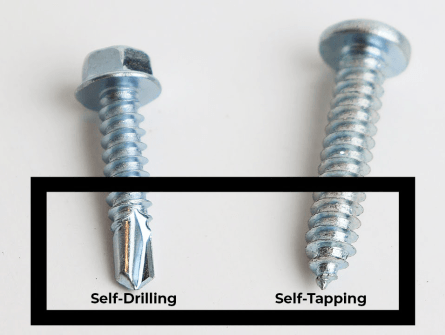
For the self-tapping and self-drilling screws debate, the pilot hole is the deciding factor. If you do not have a drill on hand, or if you are working in a tight space where switching between a drill bit and a driver bit is a hassle, self-tapping screws will slow you down. This is why in high-volume manufacturing or roof installation, self-drilling options are preferred.
Can self-drilling screws also tap their own threads?
Yes, they can. In fact, they must. A self-drilling screw is essentially a specialized subset of the self-tapping family. Once the drill point has cleared the material, the shaft of the screw enters the hole. This shaft has threads designed to tap their own threads into the metal wall of the hole. So, while screws are different in their tip design, they share the thread-tapping function.
This dual capability makes self-drilling and self-tapping screws incredibly versatile. When a self-drilling screw is driven, it performs three distinct actions in seconds: drilling, tapping, and fastening. The thread profile on these screws is specifically engineered to follow the drill tip seamlessly. If the transition isn’t smooth, the screw can bind, known as “thread jacking,” where the threads push the two materials apart instead of pulling them together.
Because they tap their own threads, you need to be careful with over-tightening. Once the head of the screw hits the surface, the drilling and tapping are done. If you keep driving it with a high-torque impact driver, you will strip the threads you just created. This is a common issue in steel framing.
Why are self-tapping screws similar to wood screws in design?
Self-tapping screws are similar to wood screws because they both rely on a sharp point and aggressive threads to hold material. In fact, many wood screws are technically self-tapping. They cut deep into the fibers of the wood. The main difference is the thread pitch and the hardness of the steel. Self-tapping screws for metal are heat-treated to be harder than the sheet metal they are fastening.
The design typically features a tapered shank. This taper allows the screw to start easily in the pilot hole and get tighter as it is driven further in. This wedging action is what provides the friction to hold the fastener securely. In contrast, a machine bolt (like the Bolt products we sell) requires a nut or a pre-tapped hole with matching threads; it does not form its own path.
We also see similarities in the drive types. Both screws come with Phillips, Hex, or Torx heads. For heavy-duty industrial work, Hex heads are preferred because they allow for more torque without the driver bit slipping (cam-out), which is crucial when the screw is cutting its own thread into steel.
Common applications for self-drilling screws in heavy industry
Applications for self-drilling screws are vast, especially in the mining and construction sectors where my company operates. They are the standard for attaching metal roofing sheets to steel purlins. You will see them used to assemble HVAC ductwork, secure electrical boxes to steel columns, and frame interior walls with steel framing studs.
In the mining environment, while we use heavy Split rock friction anchor systems for ground support, self-drilling screws are essential for the infrastructure inside the mine. They secure the mesh guards on machinery, fasten brackets for lighting, and are used in the construction of temporary site offices. The ability to fasten without carrying a separate drill and bit set makes them invaluable for maintenance crews working deep underground.
Another massive application is in metal building erection. When you have thousands of screws to install, shaving 10 seconds off each screw by eliminating the pilot hole step adds up to days of labor savings. Self-drilling screws ensure that the hole is always the perfect size for the thread, reducing inspection failures.
When should you use self-tapping screws over self-drilling ones?
You might wonder, if self-drilling screws are so great, why do we still use self-tapping screws? The answer is control and material compatibility. Self-tapping screws are better when you are working with blind holes (where the screw doesn’t go all the way through) or when you need to be very precise with hole placement. With a drill bit, you can mark your spot and drill carefully. A self-drilling screw can sometimes “walk” or slip across the surface before it bites, scratching the metal.
Also, self-tapping screws are preferred for plastic or fiberglass. A self-drilling screw with a metal-cutting point will often shatter plastic or melt it due to friction heat. A self-tapping screw with a sharp point pierces these softer materials cleanly.
Furthermore, if you are fastening multiple layers of thick steel that exceed the capacity of a standard drill point, you are better off drilling a pilot hole with a heavy-duty cobalt drill bit and then driving a heavy-gauge self-tapping screw. Attempting to force a self-drilling screw through 1/2 inch plate steel is usually asking for a snapped screw.
How do materials like stainless steel affect your choice of fastener?
The material the screw is made of and the material it is going into are critical factors. Stainless steel is a popular choice for corrosion resistance, but it is softer than carbon steel. Stainless steel self-drilling screws often have a hardened carbon steel tip welded onto them (bi-metal screws) because stainless alone is too soft to hold a sharp cutting edge against structural steel.
If you try to use a standard stainless self-tapping screw into hard steel, the threads will flatten. You must use a pre-drilled hole that is slightly larger than usual to reduce friction. In contrast, standard zinc-plated screws (like many types of self-drilling screws) are hardened through and through, making them excellent for drilling but less resistant to rust over time.
In our line of work, we often deal with galvanized coatings. When you use a self-drilling screw on galvanized steel, the drilling action strips the coating from the hole. It is vital to use a screw with a sealing washer (neoprene) to prevent water from entering that raw edge, especially on a roof. This is similar to how we use Black Anchor Plated components; protection is key.
Tips for fastening metal to metal without stripping the threads
Fastening metal to metal requires finesse. The most common mistake is over-driving. When the screw seats, stop. If you keep spinning it, the metal threads you just formed will shear off, and the screw will spin freely—offering zero holding power. Using a drill with an adjustable clutch is the best way to prevent this. Set the clutch so it slips just as the screw tightens.
Another tip is to watch your speed. High RPMs are good for the drill phase of a self-drilling screw, but once the threads engage, you should slow down. If you hit the tapping phase at full speed, the shock can snap the head.
Finally, ensure your screws come from a reputable supplier. Cheap screws often have dull drill points or inconsistent thread sizes. In safety-critical industries, using certified fasteners—whether they are tiny screws or massive Threaded steel anchor bolts—is non-negotiable.
Summary
Here are the most important things to remember about self-tapping and self-drilling screws:
- Self-tapping screws create their own threads but usually require a pilot hole before installation.
- Self-drilling screws (Tek screws) have a drill point tip that drills the hole and taps the thread in one go.
- Use self-drilling screws for speed on metal building assembly, roofing, and HVAC.
- Use self-tapping screws for plastic, precise alignment, or when the metal is too thick for a self-driller.
- Pilot holes are crucial for self-tappers; too big and they strip, too small and the screw snaps.
- Always match the screw material and coating to the environment to prevent corrosion.
- Do not over-tighten; once the screw is seated, the job is done.
By understanding these key differences, you can ensure your projects are built securely, efficiently, and safely. Whether you are dealing with nuts and bolts or simple screws, the right knowledge is the best tool in your box.
Post time: Mar-06-2026